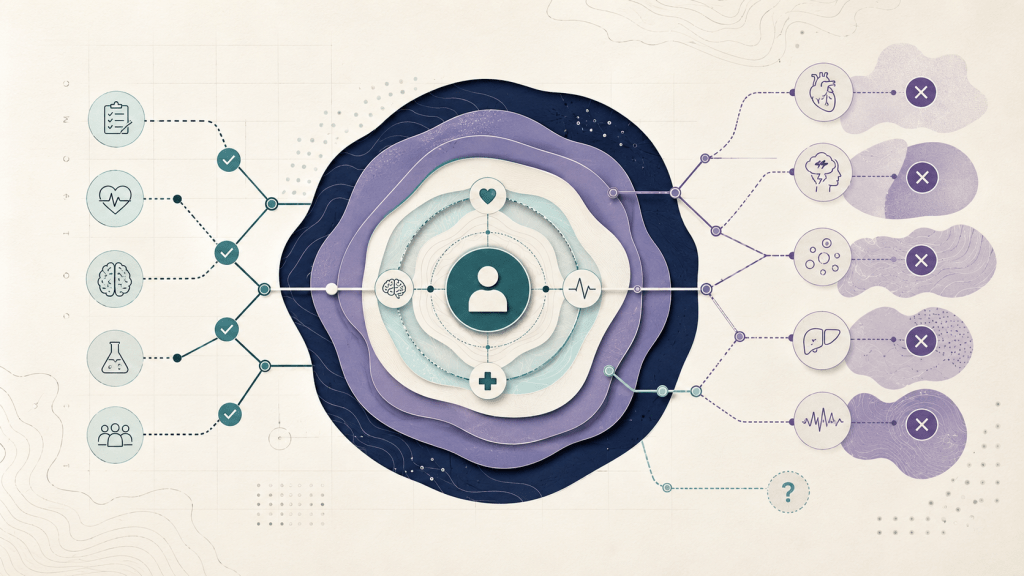
Screening is one of the most important—and most misunderstood—features of psychedelic research. It reduces foreseeable risk and creates a population suited to the study question. It does not certify that an intervention is safe for everyone who passes.
Trial eligibility decisions combine medical judgement, protocol rules and ethical oversight. Because many people with complex histories are excluded, the safety profile observed in a trial may be more favourable—and less generalisable—than the profile in routine or unsupervised use.
ARTICLE AT A GLANCE
01
Selection is not reassurance
A screened trial population is deliberately narrower than the public. Its results do not apply automatically to excluded groups.
02
Risk has several layers
Acute psychological effects, physical changes, medication issues, safeguarding and longer-term uncertainty all matter.
03
Monitoring changes the context
Trained staff, controlled products, emergency procedures and follow-up are part of the safety system.
In this guide
What screening is designed to do
Screening helps researchers identify people who meet the diagnostic question and can participate with an acceptable level of foreseeable risk. It also reduces factors that might obscure outcomes, such as unstable illness, incompatible medicines or conditions requiring another form of care.
The protocol defines minimum rules, but individual assessment remains important. A checklist cannot capture every interaction between physical health, mental health, social circumstances and the demands of an intense psychoactive experience.
Why trials exclude people
Psychedelic studies commonly use extensive exclusion criteria. Depending on the substance and protocol, investigators may consider cardiovascular status, pregnancy, seizure history, current medicines, substance-use patterns, acute suicide risk and personal or family histories relevant to psychosis or mania. (FDA final guidance, 2026)
These exclusions serve participant protection and scientific clarity. They also create an evidence gap: if a group was not studied, absence of observed harm in the trial cannot be treated as evidence of safety for that group.
Acute and longer-term psychological risk
During a psychedelic session, anxiety, panic, confusion, fear and loss of orientation can occur. In a controlled setting, staff prepare for distress, remain present and intervene if necessary. A challenging experience is not automatically an adverse event, but severity, duration and functional impact should be assessed rather than romanticised.
NHS guidance notes that substances including LSD, psilocybin, MDMA and ketamine can trigger psychotic episodes. Trials seek to reduce this risk through selection and monitoring. Rare or delayed outcomes remain difficult to quantify in small samples. (NHS: causes of psychosis)
Physical health and medication considerations
Different compounds have different physiological effects. Blood pressure, heart rate, temperature, sedation, nausea and coordination may be relevant depending on the investigational product. A controlled session may include baseline observations, repeated monitoring and predefined stopping or emergency criteria.
Medication questions are substance- and person-specific. Researchers may require supervised changes before enrolment, but readers should not copy trial washout rules or alter prescribed treatment themselves. Stopping psychiatric or other medicines can create serious risk.
Safeguarding, consent and power
Psychoactive sessions can increase vulnerability, suggestibility and dependence on staff. Ethical delivery requires explicit boundaries, informed consent before impairment, rules about touch, chaperoning where appropriate, supervision, reporting routes and independent responses to concerns.
Consent is a process, not a signature. Participants need understandable information about uncertainty, alternatives, confidentiality, recordings, the right to withdraw and what care is available if symptoms worsen.
How adverse events should be collected
Safety data depend on how researchers ask. Open-ended questions, symptom checklists, clinician judgement and spontaneous reports can produce different totals. Reports should define the observation period, event severity, seriousness, relatedness and whether an event caused withdrawal.
A 2024 framework for psychedelic-assisted therapy research argued for more consistent assessment because heterogeneous reporting makes studies hard to compare. Reviews of classic psychedelic trials similarly find that severe events are uncommon in controlled settings but safety evidence is limited by selected samples and reporting quality. (adverse-event framework, 2024; systematic review, 2024)
Why the trial context is not transferable
A clinical trial uses a known product, measured dose, trained team, emergency plan, documented consent and scheduled follow-up. Unsupervised, informal or commercially variable settings may lack several of these protections.
That difference does not mean every controlled trial is safe or every non-trial experience causes harm. It means evidence from one context cannot establish the risk profile of another.
Safety questions to ask of a protocol
Responsible readers can look for concrete safeguards rather than vague assurances:
- Who was excluded, and how does that affect generalisability?
- How were physical and psychological risks assessed?
- What training, supervision and safeguarding rules applied to staff?
- How were adverse events actively collected and followed?
- What happened after deterioration, withdrawal or a serious event?
- Were safety findings reported for every randomised participant?
The responsible safety claim
Screening and supervision make research more controlled; they do not make an intervention universally safe. The correct conclusion is bounded by the population, protocol, dose and follow-up that were actually studied.
Good safety reporting acknowledges what is known, what is actively managed and what the available sample is too small or selective to reveal.
Safety and scope
This article intentionally does not provide a personal eligibility decision or a self-screening checklist. Do not stop prescribed medicines or use a research protocol to make treatment decisions. Individual risk requires assessment by qualified professionals with access to the relevant medical history.
ARTICLE RECORD
- Editorial category: Safety & Ethics
- Evidence status: Safety-literacy guide; risks and eligibility vary by substance and protocol
- Sources checked: 29 July 2026
- Independent clinical review: Not currently listed
Sources and further reading
- FDA psychedelic clinical-trial guidance — screening, safety monitoring, bias and investigator considerations
- NHS: Causes of psychosis — current NHS information on drug-related psychotic episodes
- Assessment of adverse events in psychedelic-assisted therapies — 2024 framework for standardised safety assessment
- Adverse events in classic psychedelic trials — systematic review and meta-analysis
- UK Parliament POST: Psychedelic-assisted therapy — UK evidence and policy considerations
Editorial note: This article is for education and evidence literacy. It is not medical advice, a diagnosis, a recommendation to use a substance, or a substitute for care from a qualified professional.

